
Authors: Ms Gunjan Soni, International Lawyer and Co-Lead, Indian National Front, World’s Youth for Climate Justice; Assistant Professor, School of Law, Mahindra University; and Ms Aditi Shetye, Lead of Strategic Litigation, World’s Youth for Climate Justice.
In democracies, the State is duty-bound to act for the benefit and in the interest of its people. For natural resources, among other things, this idea translates into the public trust doctrine (PTD), where the State acts as the trustee of natural resources on behalf of the public. When the State takes action that seeks to violate this trust by choosing development or private interests over the public interest, the application of PTD is necessitated.
In this situation, as the guardian of the constitution, the Indian judiciary is tasked with ensuring that people’s trust remains intact. The PTD, as an essential and longstanding principle of Indian environmental law, mandates the judiciary to undertake a heightened level of judicial review of any administrative action that seeks to displace this trust [para 87, Re Special Reference No. 1 of 2012 (SC, 2012) (Presidential Request)].
This blog argues that the necessity of heightened judicial review arose in the Aravalli case, which the Supreme Court initially did not consider in its November judgment. In that judgment, the executive proposed to define Aravalli Hills as “any landform [with] an elevation of 100 meters or more from the local relief”. The Supreme Court, in its November judgment, accepted this definition without any judicial scrutiny or discussion regarding the impact of this definition on the ecosystem in the Aravalli Hills. Given that the Aravalli Hills are a natural resource, they are a subject of protection under the PTD. Therefore, the judiciary, when faced with this definition, was obligated to undertake a heightened level of judicial review of the executive’s action. This was to be done to ascertain whether the proposed definition was beneficial for the public. By accepting the definition without such a review, the Supreme Court ignored a well-established fundamental principle of the Indian environmental law jurisprudence.
We argue this based on three counts: (i) the executive’s action necessitated application of the PTD, (ii) the Supreme Court, in its November judgment, failed to exercise judicial review and accepted the definition without considering its impact on present and future generations, and (iii) the Court’s failure to exercise heightened scrutiny at the threshold has compounded the burden of (environmental) litigation, which is contrary to the imperative of judicial efficiency.
PTD and its role in shaping environmental jurisprudence in India
The decision in MC Mehta v. Kamal Nath (SC, 1996) (Kamal Nath) marked the entrance of PTD in Indian environmental law jurisprudence. The case concerned a challenge to the leasing of a protected forest land by the government to a private hotel for commercial purposes. While declaring the government’s action as unlawful, the court held that the Indian legal system includes PTD as part of its jurisprudence. Expounding on the doctrine, the court observed that “[t]he State is the trustee of all natural resources…meant for public use” and the public is the beneficiary of this trust. As such, the State, under PTD, has the “legal duty to protect the natural resources [which are] … meant for public use and cannot be converted into private ownership” [para 34, Kamal Nath].
In subsequent cases, the Supreme Court has used PTD several times to protect natural resources from being opened to private usage. It has protected public parks, people’s right to access light, air and water by refusing restrictions on public access to beaches, and ensuring the right of future generations to natural resources by protecting forests. In this manner, the court has affirmed that the “doctrine imposes restrictions on governmental authority on the use and allocation of trust resources” [Madhav, 2024][1], thereby providing an effective remedy to citizens to hold their governments accountable for their actions.
The executive’s decision to supply a narrow definition to the Aravalli Hills mandated the application of PTD
Grounded in Articles 21, 48A and 51-A(g) of the Indian Constitution, the doctrine establishes that the public has a right to expect certain natural resources, including natural lands like forests, to retain their natural characteristics [para 23, Kamal Nath]. This doctrine enjoins a duty on the government to protect natural resources for the public rather than permitting their use for private ownership or commercial purposes. The application of this doctrine ensures the availment of the right to a healthy environment under Article 21
[para 9, Swachh Association v. The State of Maharashtra (SC, 2025) (Swachh)]
and thus, by extension, the right to be protected from the adverse effects of climate change [para 27, MK Ranjitsinh v. Union of India (SC, 2024) (Ranjitsinh)]. The Supreme Court has observed that this doctrine grew from the fundamental right to life under Article 21 of the Indian Constitution [para 10, MI Builders v. Radhey Shyam Sahu (SC, 1999)]. As such, according to PTD, the government has the affirmative duty to actively prevent the infringement of the community’s rights [para 91, Intellectuals Forum v. State of Andhra Pradesh (SC, 2006); paras 26 and 32 Environment Protection Committee v. Union of India (Gauhati HC, 2011)].
By defining the Aravalli Hills narrowly, the executive’s action had the potential to remove protection from the majority of the forest. A spatial ecological analysis by ATREE, conducted in February 2026, assessed the impact of this definition on the local environment and communities. It concluded that, based on the 100m definition, in Rajasthan, over 70% of the Aravalli forest would lose protection. For Gujarat and Haryana, this figure is even higher at 82%. In Delhi, the entirety of the Aravalli Forest would become unprotected. This shows that the definition would substantially limit public access to the Aravalli Hills and open it to private extractive activities. The lack of protection has the potential to alter the natural characteristics of the Aravalli forest drastically.
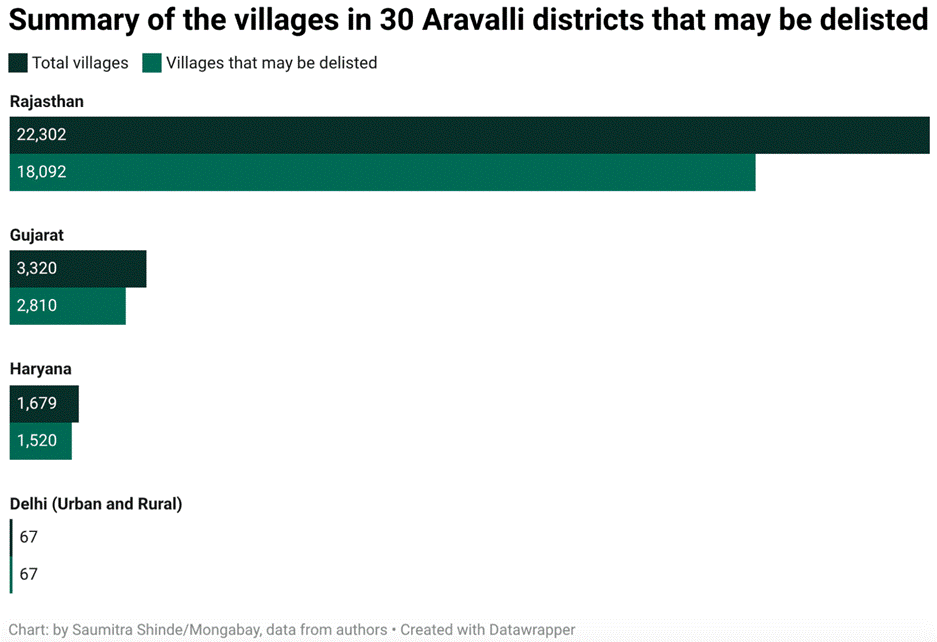
Figure reproduced from the spatial ecological analysis conducted by ATREE and published by Mongabay on 09 February 2026 [here].
Further, if private extractive activities are allowed in this area, it may increase the risk of worsening the air pollution crisis in North India, considering that the Aravalli forests serve as the green lung of this region. This will directly impinge on the citizens’ fundamental right to a healthy environment and climate. Beyond this localized impact, the carbon sequestered by the Aravalli forest contributes to reducing India’s greenhouse gas emissions. Any alteration in its natural characteristics may result in the violation of people’s right to be protected from the adverse effects of climate change, as well as run counter to India’s international obligations under, inter alia, international environmental law, and the Paris Agreement.
Given this background, the government’s action of proposing such a narrow definition of the Aravalli Hills clearly fell short of fulfilling its duty to protect such natural resources for the public, thus mandating a stringent application of PTD.
The Supreme Court failed to exercise its power of judicial review
Absent legislation, the executive’s action must be governed by the PTD[2] because it cannot “abdicate the natural resources and convert them into private ownership, or for commercial use” [para 35, Kamal Nath]. While PTD does not impose an embargo on alienation of trust property, it requires a high level of judicial scrutiny on the executive’s action that could restrict public access to a natural resource [para 76, Intellectuals Forum].
This exercise of judicial review must evaluate the quality of the executive’s decision-making process on three parameters [Ghosh, pp. 249 to 251]. First, whether the decision undertook an adequate assessment of all relevant considerations before the usage of the natural resource. Second, whether the decision-making process was transparent and non-arbitrary, and governed by the principles of equality, justice and fairness. Third, whether the decision protected the rights of both present and future generations.
Firstly, as specified above, it is clear that the executive did not consider the impact of the 100 meters definition on the delisting of villages and loss of forest in the Aravalli districts. Therefore, it can be argued that there was a lack of adequate assessment of all relevant considerations before finalizing the 100 meters definition. Secondly, it is also not clear whether due consideration was given to the ecological function of the area while determining the definition of the Aravalli Hills, raising questions regarding the transparency and arbitrary nature of the executive action. Thirdly, if accepted, the definition has the potential of opening a significant amount of the Aravalli forest to mining and private usage, which may lead to irreversible harm being caused to the area, affecting the rights of the present and future generations.
Given that the definition has received backlash regarding its quality on each of these parameters, this was a clear case in which the Supreme Court was required to exercise rigorous procedural scrutiny, given that PTD imposes a more demanding obligation on the Government.
The PTD manifests in both the right to a healthy environment and the right to be protected from the adverse effects of climate change. The Supreme Court’s lack of engagement with the quality of the definition and its implications signified that the court fell short of fulfilling its constitutional duties to protect fundamental rights of the present and future generations.
Moreover, this kind of regulatory dilution through such technical abstractions leads to hollowing out substantive safeguards and minimizing due diligence in future cases. The November judgment has acutely illustrated this technical abstraction. By accepting the elevation threshold of 100 meters without undertaking adequate assessment of all relevant considerations, including downstream effects on erosion of forest cover, biodiversity, and lack of carbon sequestration, the Court allowed a technical definition to displace the ecological inquiry that PTD demands.
Unfortunately, this is an overarching pattern that is not confined to the Aravalli case. The Forest (Conservation) Amendment Act, 2023, has similarly narrowed the legal definition of ‘forests’, thus stripping unclassified and deemed forests of protection by definitional narrowing.[3] Additionally, in the context of international climate obligations, such rollbacks, achieved through restrictive redefinition rather than explicit legislative repeal, risk constituting a breach of the duty to prevent significant harm to the climate system, precisely because they hollow out protection whilst preserving its formal appearance.[4] Where courts accept such definitions without scrutiny, they set interpretive precedents that foreclose future challenges: subsequent litigants face the additional burden of dislodging settled judicial authority before reaching the ecological merits at all.[5] Fortunately, in the Aravalli case, the Court has taken a rare step of staying its own order to recalibrate the definition based on a holistic expert assessment of geological and ecological realities.
A further, secondary and consequential effect of the Court’s abdication of its review in the first instance, is the unnecessary multiplication of litigation. Where the judiciary fails to apply PTD scrutiny at the threshold, as occurred in the November judgment, the legal dispute does not resolve; it defers and compounds. The Aravalli case itself has exemplified this as the Court’s acceptance of the flawed definition without scrutiny necessitated a subsequent challenge, a stay of its own order, and the appointment of an expert committee. Proceedings that would have been rendered unnecessary had the Court exercised its heightened review function in the first instance. Given the heavy pendency of cases before Indian courts, judicial prudence demands that environmental matters engaging PTD be resolved with rigor at the outset, rather than re-litigated at greater cost to all parties and to the public interest.
Conclusion
There has been a growing concern that India’s robust environmental jurisprudence is fading. Decisions like the present exemplify this concern. In situations where the executive’s actions seek to violate people’s fundamental rights, the judiciary is the only recourse a citizen has. As the guardian of the Constitution, the judiciary is obligated to protect citizens’ fundamental rights. However, the judiciary’s approach in the Aravalli Hills case ran counter to its previous settled jurisprudence. If such actions remain unchecked, resources held in public trust may become open to private interference. Considering that in environmental cases, the damage caused by such usage is often irreversible, compensation for such actions may also be wholly inadequate. Further, given that the climate crisis is worsening by the day and India is extremely vulnerable to its impacts, any further damage to the existing natural resources may lead to disastrous consequences and violate the citizens’ fundamental rights.
Beyond the irreversible ecological harm at stake, and given the sheer weight of India’s caseload, the Court’s failure to apply heightened review at the threshold has, as this piece has argued, produced the kind of protracted, resource-intensive litigation that precisely the Courts’ demand to avoid.
[1] Roopa Madhav, Public Trust Doctrine, in The Oxford Handbook of Environmental and Natural Resources Law in India, OUP, 2024, available at https://academic.oup.com/edited-volume/57937/chapter-abstract/475457605?redirectedFrom=fulltext.
[2] Shibani Ghosh, Public Trust Doctrine, pg. 245, available at https://www.sustainablefutures.org/wp-content/uploads/2024/03/Indian-Environmental-Law_Key-Concepts-and-Principles2.pdf
[3] Arpitha Kodiveri, ‘The Genre-Bending of Climate Litigation in India’ (Verfassungsblog, 2024) https://verfassungsblog.de/the-genre-bending-of-climate-litigation-in-india/ accessed 5 March 2026.
[4] Aditi Shetye, Ritwick Dutta and Riddhi Dey, ‘Litigation Note on Regulatory Rollback’ in ICJ AO Litigation Notes Digest (CIEL, February 2026) 14 <www.ciel.org/reports/icj-litigation-notes-digest> accessed 5 March 2026.
[5] Ashwathy Sunil, ‘Policy Ripple Effect: How the ICJ Advisory Opinion Could Shape India’s Climate Governance’ (World’s Youth for Climate Justice) https://www.wy4cj.org/symposium/policy-ripple-effect-how-the-icj-advisory-opinion-could-shape-indias-climate-governance/ accessed 5 March 2026; Gautam Patel, Consistently Inconsistent: Environmental Law and the Supreme Court, in [In]Complete Justice? The Supreme Court at 75, S. Muralidhar (ed.), 2025, pp. 407-413.
 Climate and Law Initiative India
Leave a comment